Bonnie E. Saltzman · court-appointed Child’s Legal Representative (CLR)
Bonnie Saltzman: seven documented examples, in her own words. The complaint died at intake — judged by the standard the Supreme Court's rules save for a hearing.
OARC’s own correspondence implies that the complaint met the intake threshold. It never said the intake test failed.
Final to the complainant. No appeal as of right. Colorado closes roughly ninety-five percent of complaints at that gate.
Bonnie E. Saltzman · Colorado Attorney Registration #18973 · Law Offices of Bonnie E. Saltzman, LLC · Greenwood Village, Colorado
Executive summary
OARC effectively conceded that the allegations cleared the “if proved” intake threshold—then used a later-stage burden to kill the complaint before any formal investigation.
The Supreme Court did not give intake that power. OARC substituted an unstated categorical gate and a Committee-only clear-and-convincing test for the rule that actually governs intake.
- OARC had the evidence in hand: the 92-page, 18-exhibit packet tied seven selected examples to Saltzman’s own words in transcripts; emails she sent or participated in; her filings; and court orders.
- The written intake gate: Rule 242.13(b)(1) asks whether the alleged conduct, if proved, would warrant discipline; if so, the matter proceeds to formal investigation or eligible diversion.
- OARC implicitly acknowledged that gate was met: by applying the higher clear-and-convincing standard, it treated the alleged conduct as disciplinary if proved and rejected the evidence only as insufficient under the later standard.
- Wrong stage, wrong decision-maker: the Supreme Court placed the predictive clear-and-convincing formulation with the Court-appointed Committee after formal investigation under Rule 242.16(b)(1)—not with intake.
- The decision-makers: Jill Perry Fernandez (Colorado Attorney Reg. #18552) dismissed the complaint; April M. McMurrey (Colorado Attorney Reg. #34194) adopted that result; and Jessica E. Yates (Colorado Attorney Reg. #38003) received the rule-based objection. Together, their actions left the documented allegations against Bonnie E. Saltzman (Colorado Attorney Reg. #18973) untested by formal investigation.
- A review the public is not told about: the Office’s Annual Report describes a review of intake determinations available on request from Regulation Counsel or a Deputy. No rule mentions it, and neither dismissal letter mentioned it.
- The Court left the standards alone: in December 2025 the Supreme Court amended Rules 242.13, 242.16 and 242.30 and left all three standards unchanged, while giving the Office express authority to adopt internal practices.
- The consequence: the system is built on trust. Courts cannot function unless judges and attorneys honor their sworn duty of candor. When an attorney can lie without discipline and thereby subvert court decisions, the failure is not confined to one case: it corrodes the premise on which the entire system depends. OARC blocked investigators and the Committee from testing the evidence, then declared the intake closure final and unappealable as of right.
- The institutional incentive: the record does not reveal the individuals’ private motives. But OARC’s intake structure rewards rapid resolution and avoids the time, scrutiny, and independent Committee review that formal investigation requires. Here, that incentive aligned with an abdication of its regulatory responsibility.
The record is direct: this page is built from my firsthand account, the documents I submitted, OARC’s own correspondence, court records, and public sources. Nothing comes from a sealed court file. OARC never said Rule 242.13’s “if proved” test failed. By applying the higher standard, OARC implicitly acknowledged that the alleged conduct would warrant discipline if proved—then used a gate the Colorado Supreme Court did not authorize to stop the matter at intake.
The attorney’s conduct
Seven examples. Not the whole record.
A Child’s Legal Representative is appointed for one purpose: to protect the children’s best interests. The record contains more than the seven examples below. I selected these because they are among the clearest and easiest to verify. Taken together, they describe a broader pattern involving care, candor, diligence, records, conduct outside the appointment, and the responsibilities owed to the children.
1. My documented account: therapeutic care she was charged with coordinating went undelivered
The governing orders provided for the children’s individual and/or family therapists and placed the CLR in the role of coordinating that care. Ms. Saltzman told the court the children needed therapy — yet, by her own later written communications, the therapy was not occurring.
Rules, sources and supporting record
Rules she had a duty to follow—and chose not to: Colo. RPC 1.1 (competence) & 1.3 (diligence); C.R.S. § 14‑10‑116 (role of the CLR). A sustained failure to act on a client’s known need is neglect. People v. Ain, 35 P.3d 734 (Colo. 2001).
Basis: my own firsthand knowledge, the communications I received, and what I witnessed in court.
Is this what a Child’s Legal Representative who takes her role seriously does?
2. My records contradict the cost barrier presented to the court
Ms. Saltzman represented to the court that insurance co‑pays were a burden and that cost stood in the way of the children’s care. The benefit records I cite show a $0 co‑pay and $0 deductible for these services. She had been given the plan’s Summary of Benefits document — and, on the record in open court, my attorney corrected her and told her there were no deductibles and no co‑pays. The judge directed her to contact my attorney to get the details. She did not. My records also show the children were separately enrolled in the State children’s health plan (CHP+) — meaning there was no cost at all — yet the cost narrative continued.
Rules, sources and supporting record
Rules she had a duty to follow—and chose not to: Colo. RPC 3.3(a)(1) (knowing false statements to a tribunal) & 8.4(c) (dishonesty). People v. Layton, 494 P.3d 693 (Colo. 2021), holds that recklessness can satisfy Rule 8.4(c), while expressly recognizing that a rule requiring knowledge has a different mental-state requirement. A statement is material if it could influence the court. In re Fisher, 202 P.3d 1186 (Colo. 2009).
Basis: the plan’s Summary of Benefits, the children’s CHP+ enrollment, and what I witnessed in court — my attorney’s on‑the‑record correction and the judge’s direction that she follow up.
Is a cost excuse—for care my records show cost nothing—what the children’s own attorney is supposed to tell the court?
3. My documented account: blaming the non‑custodial parent for the lack of therapy
Rather than act, Ms. Saltzman blamed the non‑custodial parent for the children not being in therapy — a narrative contradicted by the record and one she did not verify before repeating it to the court.
Rules, sources and supporting record
Rules she had a duty to follow—and chose not to: Colo. RPC 1.3 (diligence) & 8.4(d) (conduct prejudicial to the administration of justice). Discipline follows a misrepresentation of the state of a matter. People v. McCaffrey, 925 P.2d 269 (Colo. 1996).
Basis: the communications I received and my own records.
Is blaming a parent — instead of getting the children help — the job of a children’s representative?
4. My documented account: a ready, no‑cost provider was handed to her and not used
A no‑cost, in‑network provider willing to see the children was identified and forwarded directly to Ms. Saltzman. Days earlier she had told the court that finding a provider was very difficult, and she claimed to have spent dozens of hours calling therapists without success. She is a Child’s Legal Representative — a court‑appointed role that should carry real weight with providers. No care followed.
Rules, sources and supporting record
Rules she had a duty to follow—and chose not to: Colo. RPC 1.1 (competence) & 1.3 (diligence). A protective or “good” motive is no defense to a false or misleading statement. In re Pautler, 47 P.3d 1175 (Colo. 2002).
Basis: the provider information I forwarded to her, and what I witnessed in court.
If a court‑appointed children’s attorney truly could not place a single child after “dozens of hours,” what does that say — and if a ready provider was handed to her, why was it ignored?
5. The filing I cite: moving to cut off a parent’s access to the children’s records
Ms. Saltzman moved to bar a parent from the children’s school, medical, and other records — the very records that would have documented whether the children’s needs were being met. The motion devoted far more attention to attacking a child‑welfare advocate than to the children’s care.
Rules, sources and supporting record
Rules she had a duty to follow—and chose not to: Colo. RPC 1.7 (personal‑interest conflict) & 8.4(d). A CLR remains fully bound by the Rules of Professional Conduct. People v. Gabriesheski, 205 P.3d 441 (Colo. App. 2008).
Basis: my own firsthand knowledge of the motion she filed affecting my access to the children’s records.
Whose interest is served by suppressing the records that show how the children are doing?
6. My documented concern: conduct outside the representation entirely
The Colorado Secretary of State record identifies Bonnie E. Saltzman as the registrant of a business name used by another person. Her June 14, 2024 Joint Trial Management Certificate also designated my office landlord and leasing contacts as her lay witnesses. She did not ultimately call them. I told OARC that Ms. Saltzman had contacted those third parties and listed them in her own filing. The state filing and her own witness designations corroborate the broader interference allegation. Neither matter had anything to do with representing the children.
Rules, sources and supporting record
Rules she had a duty to follow—and chose not to: Colo. RPC 4.4(a) (no substantial purpose other than to burden a third person) & 8.4(d). Even where immunity applies, it does not relieve an attorney of the rules governing the profession. Stepanek v. Delta County, 940 P.2d 364 (Colo. 1997).
Basis: the public Colorado Secretary of State record, the CLR’s June 14, 2024 Joint Trial Management Certificate, and Count 6 of my filed OARC request.
What does reserving a critic’s business name have to do with a child’s best interests?
7. My records contradict the claim that the children’s absences were excused
In a signed motion, Ms. Saltzman represented to the court that the children’s school absences “were excused.” They were not. All three children were truant during the 2024 school year — a fact communicated to her by three independent sources: me, the court’s own Child and Family Investigator, and the children’s mother. She had also personally requested the children’s attendance and grade records weeks before she signed that motion. The eldest crossed Colorado’s habitual‑truant threshold while still sixteen and did not graduate; the basis she gave for calling the absences “excused” is not one the truancy statutes recognize. When pressed, she pivoted to claiming the child was “over seventeen” and could elect not to attend — but he did not turn seventeen until months later. A shifting, contradictory account of the same fact is evidence she knew the first version was false.
Rules, sources and supporting record
Rules she had a duty to follow—and chose not to: Colo. RPC 3.3(a)(1) (candor to the tribunal). Statutes: C.R.S. § 22‑33‑104 (compulsory attendance) & § 22‑33‑102(3.5) (habitual truant). A knowing false statement to a tribunal is grounds for discipline. People v. Varallo, 61 P.3d 38 (Colo. 2002).
Basis: my own firsthand knowledge, the attendance records I hold, and the records request she sent me.
Should a children’s attorney tell a court something the records in her own hands contradict?
A larger pattern, not seven isolated incidents
These are seven selected examples—not the entire record. Taken together, statements contradicted by records, blame‑shifting, ignored help, an attempt to restrict access to the children’s records, and conduct aimed at critics rather than the children show a representative working against the interests she was appointed to protect.
Is this what a real Child’s Legal Representative — one who cares about her role and her responsibilities — does?
The human consequence
This did not stay inside a regulator’s file. It reached my relationship with my children.
Ms. Saltzman’s conduct, the court record, and resulting orders made it harder to see and parent my children. The Supreme Court recognizes a liberty interest in children’s care, custody, and control. The harm reached a fundamental constitutional interest.
“The interest of parents in the care, custody, and control of their children—is perhaps the oldest of the fundamental liberty interests recognized by this Court.” — Troxel v. Granville, 530 U.S. 57, 65 (2000)
Chronology matters: OARC’s June–July 2026 closure followed the challenged conduct and restrictions, so it did not cause the original orders. Its refusal to investigate left the record uncorrected, concealed any repeat warnings, and removed the disciplinary check that should have tested the evidence.
A fundamental right deserves evidence, precision, and a regulator willing to follow the rules it enforces.
The intake gate in numbers
The scale of the intake gate is visible in OARC’s own 2025 Annual Report:
500–600matters handled by each intake attorney per year, according to OARC.
5.3 weeksaverage intake processing time in 2025.
33formal complaints filed in 2025, involving 67 separate requests.
What the numbers show
OARC’s latest annual report shows the scale of the gate:
4,624requests for investigation received in 2025—up 4.4% from 2024 and 36% from 2019.
210matters processed to the Trial Division for further investigation: 4.5%.
95.5%of 2025 requests did not advance to the Trial Division for further investigation.
That is roughly one referral for every twenty-two requests received. The published numbers establish how rarely a complaint reaches formal investigation; they do not establish whether any individual allegation was true or false. Colorado OARC, 2025 Annual Report
OARC’s report calls intake an “initial review and analysis” and separately identifies the Trial Division’s “further investigation.” It also reports that after Trial Division referral, only one dismissal-review request was made in 2025; the dismissal was sustained, and none was reversed.
Each intake attorney: 500–600 matters ÷ roughly 200 working days = 2.5–3 matters every working day.
For each intake attorney, an eight-hour day leaves only about 2.7–3.2 gross work hours per matter—and that assumes the intake attorney does nothing else: no meetings, training, leave, administration, calls, or other duties. OARC’s annual report supplies the 500–600 figure; the arithmetic is mine.
At that pace, the intake system is structured for rapid denial, not meaningful scrutiny. The numbers describe a denial factory; OARC does not disclose substantive work sufficient to rebut what its own figures show.
A screen that sends roughly one matter in twenty to further investigation is a powerful filter. But a filter measures what gets through it—not what was true. That a complaint was closed at intake does not mean the underlying conduct did not happen. It means OARC decided not to proceed further.
Why is Colorado so different?
This comparison has been verified against official reports. Different states use different labels and reporting years, so this is not a perfect league table. But those differences do not explain a gap this large—or why Colorado keeps final intake review inside the same office.
| Jurisdiction | Published intake denominator | Referred for further investigation | Share | Complainant check outside intake office | Necessary caution |
|---|---|---|---|---|---|
| Colorado | 4,431 complaints (2024) | 205 to Trial Division for further investigation | 4.6% | No appeal as of right outside OARC. Supreme Court supervision is extraordinary and discretionary. | Directly reported further-investigation event. |
| Arizona | 2,969 charges | 523 referred to investigation | 17.6% | Yes. A complainant may appeal a State Bar dismissal to the Supreme Court’s independent Attorney Discipline Probable Cause Committee. | Closest published event; “charges” may not be identical to Colorado “complaints.” |
| Oregon | 1,756 opened 1,869 resolved | 257 referred to Disciplinary Counsel | 14.0% published | No outside appeal at intake. A right to General Counsel review remains within the Oregon State Bar; that decision is final. | The report publishes 14.0% and 16.3% of merits-evaluated inquiries, but its opened, resolved, and referred counts are not a closed cohort. |
Colorado: 4.5% reached further investigation in 2025
210 of 4,624Buried in Appendix D on printed page 69, OARC says a complainant may ask Regulation Counsel or a Deputy to review an intake decision. That is the same Office reviewing its own gatekeeping—not an independent appeal, not a mixed public panel, and not a meaningful outside check. Rule 242.13 makes the intake disposition final as to the complaining witness.
Arizona: 17.6% referred in 2024
17.6% referredIn the same 2024 reporting year, Arizona reported 2,969 charges and sent 523 to investigation. Colorado reported 4,431 complaints and sent 205 to its Trial Division—4.6%. Arizona’s referral share was about 3.8 times Colorado’s.
Arizona had 1.63 million more residents, yet Colorado reported 1,462 more intake units—about 1.9 times as many per resident. Different labels make this a warning sign, not a merits verdict. Arizona’s 523 referred charges involved 313 lawyers; its six-lawyer, three-public-member committee can order more investigation and hear complainant objections.
Arizona receives fewer charges while ringing the bell far more often. A system that investigates more readily, permits mixed public review, and imposes visible consequences sends a deterrent warning before misconduct repeats. The figures are consistent with deterrence and make the question unavoidable: does Arizona see fewer complaints because lawyers know its regulator will act?
Oregon: 14.0% referred in 2024
257 referralsOregon publishes 257 referrals, a 14.0% share (16.3% of merits-evaluated inquiries), versus Colorado’s 4.6% in the same 2024 reporting year. Because Oregon’s opened, resolved, and referred counts are not a closed cohort, this page uses its official rate. Its internal General Counsel affirmed all 266 requested reviews in 2024: a wider gate did not make same-office review meaningful.
Texas and Washington: someone else can check
Outside the intake deskTexas permits appeals to an independent tribunal and uses mixed lawyer/public panels. Washington’s two-lawyer, one-community-member committees sent 40 matters to hearing and 15 back for investigation in 2024. Colorado offers no outside appeal as of right; Supreme Court supervision is extraordinary and discretionary.
The missing Colorado number: how many unique attorneys drew those complaints?
Colorado does not publish how many attorneys drew its complaints, how many were repeat respondents, or how often repeated complaints ended at intake. Arizona reports 523 referred charges involving 313 lawyers. Without Colorado’s denominator, the public cannot know whether warnings are stacking up against a smaller group.
Funding tested—not assumed
The payer is broadly the same. The gate is not.
Colorado’s result cannot be explained simply by saying that lawyers fund the regulator. The comparison systems are also funded principally by the profession they regulate.
ColoradoAttorney-registration fees; no tax dollars.
ArizonaState Bar member fees; no tax dollars.
TexasNo tax dollars; dues and other Bar revenue.
WashingtonLicense fees; no public funding, under 2% alternative revenue.
OregonAbout two-thirds of Bar revenue from licensing fees.
ABA’s 2023 survey reported budgets of $8.9 million in Colorado, $4.8 million in Arizona, $6.4 million in Washington, and $10.5 million in Texas—about $309, $248, $191, and $95 per active lawyer, respectively. Different system scopes make this context, not an efficiency ranking.
If lawyers largely pay in every state, why does Colorado open the investigation gate so much less often—and why is there no appeal as of right outside OARC?
What the figures establish: the reporting labels and cohorts differ, but the gap is unmistakable. Colorado sends a far smaller share beyond intake, keeps final intake review inside OARC, and withholds the respondent-level data needed to identify repeat complaints. Population and lawyer-funded regulation do not explain that structure.
“If men were angels, no government would be necessary. … you must first enable the government to control the governed; and in the next place oblige it to control itself.” — James Madison, Federalist No. 51
OARC controls the front gate. Colorado’s question is who independently controls OARC when that gate closes.
In their own words — the exchange
Here are OARC’s words beside my response, so readers can judge the review.
The dismissal — Jill Perry Fernandez, Senior Assistant Regulation Counsel (Colorado Attorney Reg. #18552) (June 30, 2026):
“In order to pursue discipline against an attorney, this office must be able to prove that the attorney violated one or more of the Rules by clear and convincing evidence. The available information does not establish by clear and convincing evidence a violation by Ms. Saltzman …”
“to prove an attorney made an unethical misrepresentation to the court, this office must be able to prove by clear and convincing evidence that: 1) the attorney made a false statement; 2) the attorney knew the statement was false at the time that it was made; and 3) the statement was material. What you have reported … fails to meet these standards. I note there is no evidence the court made findings that Ms. Saltzman made misrepresentations …”
OARC’s “available information” was a 92-page, 18-exhibit packet supporting all seven points with transcripts, emails, filings, orders, and identified contradictions. Those contradictions document lies to the court in the attorney’s own words. By applying the higher clear-and-convincing-evidence standard, OARC implicitly acknowledged that the alleged conduct, if proved, would warrant discipline. It nevertheless closed the matter by imposing the ultimate burden of proof at preliminary intake—an additional gate that Rule 242.13 does not authorize.
“The intake division of this office does not accept email submissions. Please note that further submissions made via this email address will be deleted without being reviewed.”
“pursuant to Colorado Rule of Civil Procedure 242.13(b)(3), this decision is final and you are not entitled to further review or appeal.”
My response — to Regulation Counsel Jessica E. Yates (Colorado Attorney Reg. #38003):
“Clear and convincing evidence is the burden of proof at a disciplinary hearing … It is not the standard for a preliminary screen. Under C.R.C.P. 242.13(b)(1)(A), the only question at the screening stage is whether ‘an allegation has been made that, if proved, would constitute grounds for discipline.’”
“Had the Supreme Court intended to impose that burden at intake, Rule 242.13 would say so. Instead, the Rules place that burden exclusively at the adjudicatory stage … The Office was entitled to weigh whether credible evidence supported my allegations; it was not entitled to demand, at intake, the clear-and-convincing proof that Rule 242.31 assigns to the hearing.”
The quotation is preserved as sent. Current rules place the hearing burden at Rule 242.30(b)(3) and the Committee’s post-investigation predictive test at Rule 242.16(b)(1).
“No rule conditions the Office’s authority on a prior judicial finding … Attorney discipline is an independent process … Declining to investigate on that basis is not a neutral application of the Rules; it abandons the Office’s core function under C.R.C.P. 242 — the enforcement of the Rules against attorneys who violate them.”
The Office’s reply — April M. McMurrey, Deputy Regulation Counsel (Colorado Attorney Reg. #34194) (July 9, 2026):
“A review of this dismissal by the Legal Regulation Committee is not available under the Colorado Supreme Court rules. Pursuant to Colorado Rule of Civil Procedure 242.13(b)(3), a decision made at intake to dismiss a request for investigation is final and a complainant is not entitled to further review or appeal. This matter remains closed and dismissed.”
The later internal-review email — after I had identified the lower intake standard and the Committee’s later standard:
“As I previously advised you, there is no right to review or appeal of a decision made at our intake division. See CRCP 242.13(b)(3). Nevertheless, I reviewed Ms. Fernandez’s analysis and I agree with her. There is not clear and convincing evidence Ms. Saltzman engaged in misconduct, as you allege. This will be our office’s final communication to you regarding this matter.” — April M. McMurrey, Deputy Regulation Counsel
After the stage mismatch was squarely presented, McMurrey adopted Fernandez’s analysis, repeated clear-and-convincing language, and still did not say Rule 242.13’s “if proved” gate failed. That establishes a knowing choice of the higher gate after OARC had implicitly acknowledged the lower one was met.
The July 9 letter also bears “AMM/jpf.” “jpf” is Jill Perry Fernandez, whose original dismissal I sought to review. The letter’s markings indicate the original decision-maker helped prepare the refusal to review it—the same hand twice, not independent review.
The review the public is never told about
On July 9, 2026, the Deputy Regulation Counsel wrote that review of the dismissal "is not available under the Colorado Supreme Court rules." The Office's own Annual Report states, at page 68 of the 2025 edition and page 65 of the 2024 edition, that "at the request of either the complainant or the respondent-attorney, Regulation Counsel or Deputy Regulation Counsel reviews any determination made by a central intake attorney." On August 8, 2026, the same Deputy Regulation Counsel conducted that review. Nothing in Rule 242.13, and nothing in either dismissal letter, tells a member of the public that this review exists.
The result: a documented complaint closed under clear-and-convincing language, a judicial-finding hurdle the rules do not state, threatened deletion of email, and finality without outside appeal as of right.
It never reached formal investigators—in spite of documentary proof of the filing and witness designations. OARC closed the matter before Rule 242.14 referral. Its dismissal expressly recited my allegation that Ms. Saltzman exceeded her appointment by interfering with a third party’s Colorado business-trade-name registration and with my business affairs. My submission included the Secretary of State record naming Saltzman as registrant of the business name, and I told OARC that the CLR’s own Joint Trial Management Certificate designated third parties connected to my office lease as her witnesses. Those documents establish the filing and the witness designations. OARC had the authority and tools to investigate the underlying communications. It refused to use them.
OARC says it read the entire record—the submission, electronic registry, pleadings, and orders—then found insufficiency under later-stage language without confronting the identified contradictions. That also raises how an intake attorney outside the case accessed a registry and pleadings from a suppressed case. The simpler point: OARC had the record and closed it.
The letter tied “pursu[ing]” discipline to clear-and-convincing proof and a sanction by the PDJ. It used the finish-line question to lock the starting gate. Rule 242.13 does not give intake that additional decision-making power; had the Colorado Supreme Court intended a clear-and-convincing gate at intake, it would have written one into the rule.
OARC never answered my written conflict question. The attorneys I reported had asked OARC to pursue a third party—a matter OARC took up—while OARC refused to investigate the report about them. That unanswered asymmetry is not an even hand.
How the complaint reached OARC
How it reached OARC. I emailed only after three weeks without a promised callback, instructions not to mail, a closed office, and a website that had stopped accepting complaints. Email was the remaining channel; OARC then said it would be “deleted without being reviewed.” Its letter faulted me for writing before receiving directions that never came.
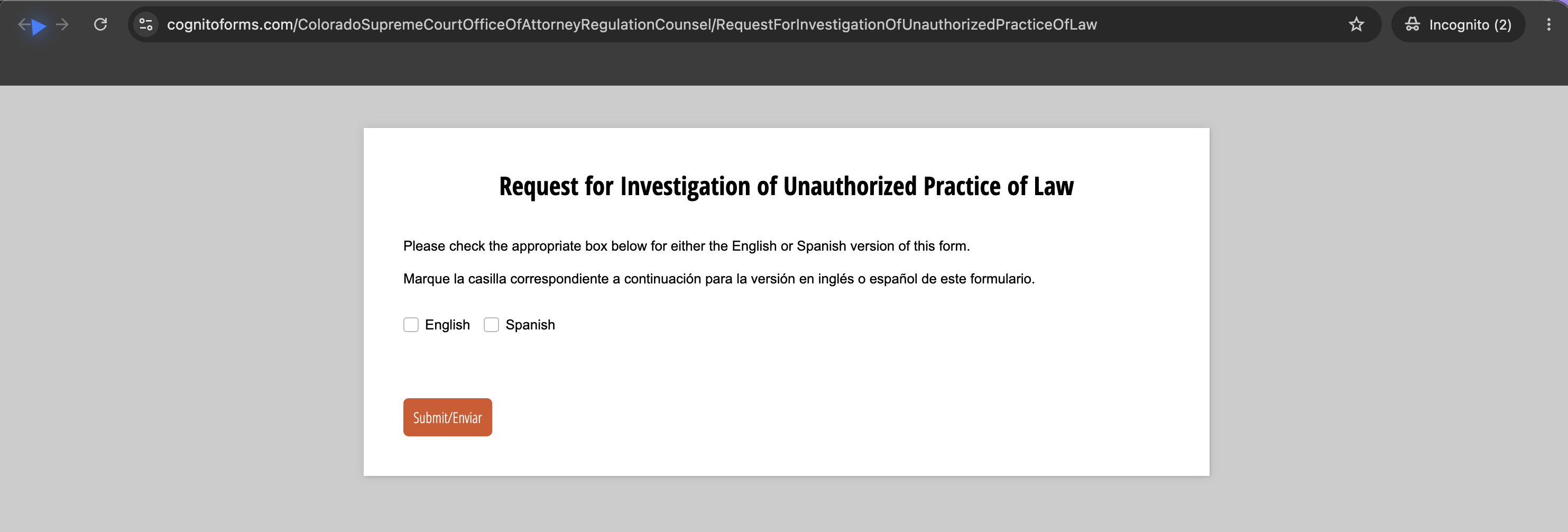

Use email. Your email will be deleted.
The Office's home page carries this notice: "A security incident the morning of Tuesday January 2, 2024 has caused damage to the office space normally occupied by the Office of Attorney Regulation Counsel, including the Attorney Admissions, LLP Admissions, Attorney Registration, and Continuing Legal Education offices. Please do not visit the Office, and if possible, use email and phone services to accomplish your communications. We appreciate your patience." That notice was still on the Office's home page on August 19, 2026.
The Office's page for filing a complaint against an attorney lists three ways to reach it: telephone, an online complaint form, and U.S. mail. The online complaint form has been marked "temporarily unavailable" continuously since at least July 16, 2026, and was still marked unavailable on August 19, 2026. The same page directs the public to telephone or mail while linking to a live Cognito Forms endpoint.
Both of the Office's online complaint forms are hosted on the same Cognito Forms account. The form for complaints against lawyers, at cognitoforms.com/…/RequestForInvestigationOfLawyer2, states: "Our office's online complaint form is temporarily unavailable while we work to improve the form." The form for unauthorized practice of law, at cognitoforms.com/…/RequestForInvestigationOfUnauthorizedPracticeOfLaw, is live and working, and is offered in English and Spanish. The two forms are hosted on the same platform under the same account, so the outage does not appear to be a platform-wide failure.
Both letters closing this matter were sent to me "via email only," and the respondent attorney was copied "via email only." The June 30, 2026 letter states: "further submissions made via this email address will be deleted without being reviewed."
Read the full documents (my name redacted; the Office’s names left intact):
- My Point-by-Point Response to the June 30, 2026 dismissal (PDF) — every stated basis for closure, answered in order.
- The Office’s July 9, 2026 reply, signed by Deputy Regulation Counsel April M. McMurrey (PDF).
The regulator’s decision
Did OARC jump beyond the authority the Colorado Supreme Court gave it?
OARC says it investigated at intake. Its own annual report calls that stage an “initial review and analysis” and distinguishes it from the Trial Division’s “further investigation.” The Supreme Court’s rules also distinguish the stages—and assign different decisions to different decision-makers.
First: the Regulation Committee is not OARC
C.R.C.P. 242.4 creates the Legal Regulation Committee as a permanent committee of the Colorado Supreme Court. The Court appoints its at least nine members, including at least six Colorado lawyers and at least two nonlawyers. OARC’s Regulation Counsel investigates and presents matters; the Committee is the distinct body empowered by Rule 242.4(c)(1) to make determinations under Rule 242.16.
What C.R.C.P. 242.13 requires at intake
Rule 242.13(b)(1) first asks whether reported conduct, “if proved,” would constitute grounds for discipline. If that threshold and jurisdiction are satisfied, intake must then decide between formal investigation under Rule 242.14 and an eligible diversion under Rule 242.17. The threshold does not itself impose discipline; it activates that next-step choice.
What OARC’s dismissal said instead
OARC said it needed clear and convincing evidence and cited the absence of a prior judicial finding. But Rule 242.16(b)(1) assigns that predictive formulation to the Regulation Committee when a matter reaches it after formal investigation; Rule 242.30(b)(3) sets the actual burden at a hearing.
The core problem
Intake turned a formulation assigned to the Court-appointed Committee at a later stage into a categorical gate that prevented the investigation and record needed before that Committee could act.
What the gate actually forecloses
An intake standard set at the hearing burden means no formal investigation. No formal investigation means no written response from the lawyer, no interviews, no procurement of documents, no subpoenas, no Regulation Committee, and no reviewable record. In a system where 4.5% of complaints go past intake, that closes the file on roughly ninety-five percent of everything the public brings. Whatever the intent, the structural consequence is the same: misconduct that could only be proved after investigation can never be investigated.
Purpose and practice
The Colorado Rules and the Office's own public materials state that the purpose of the system is protection of the public. The American Bar Association's Standards for Imposing Lawyer Sanctions — a document the Office links from its own Resources page — say the same thing at Standard 1.1: "The purpose of lawyer discipline proceedings is to protect the public and the administration of justice from lawyers who have not discharged, will not discharge, or are unlikely properly to discharge their professional duties to clients, the public, the legal system, and the legal profession."
A screening standard that guarantees the public's complaints die before the tools exist to test them is in tension with that stated purpose. The result is that attorneys whose conduct would only be established through investigation are effectively shielded from it.
The Colorado Supreme Court’s rules define the gate
Rule 242.13 instead asks “if proved,” then permits investigation or eligible diversion. It does not require a ready-made clear-and-convincing case. Rule 242.5(c)(3) permits internal practices, but that authority does not permit OARC to add a gate the Supreme Court omitted. The Court put the precise higher formulation in Rule 242.16(b)(1), not Rule 242.13.
Discretion applies the rule. It does not amend the rule.
Chessin, applying the pre-2021 rule, locates supervision in the Colorado Supreme Court; it does not authorize OARC to rewrite the intake standard. Kilgore, 2020 CO 6, ¶ 26, states the controlling principle: broad discretion “cannot expand the contours” of a carefully drafted rule.
No prior court finding appears as an intake prerequisite in C.R.C.P. 241 or 242.1–242.43. Nor did OARC ever say Rule 242.13’s lower test failed—even after the mismatch was raised. If it failed, why not say so?
The Court adopted this sequence in Rule Change 2021(07); it remains in the current rules through Rule Change 2025(27). Rule 242.5(c)(3) permits internal practices, not express amendment of a Supreme Court rule. OARC’s intake closure prevented the post-investigation request or recommendation that could trigger Committee action under Rules 242.14–.16.
The Court looked at these rules in December 2025 and changed none of the standards
The Supreme Court amended Rules 242.13, 242.16 and 242.30 on December 11, 2025. It changed the triggers for opening an investigation, the procedure for rejecting a private admonition, and the admissibility of orders entered by other tribunals. In the redline, Rule 242.13(b) — the "if proved" screen — is marked "[NO CHANGE]." Rule 242.16(a) and (b) are marked "[NO CHANGE]." Rule 242.30(b)(3) is marked "[NO CHANGE]." Rules 242.14 and 242.15 are not in the rule change at all. In the same order the Court added Rule 242.5(c)(3), authorizing the Regulation Counsel to adopt practices governing the internal operation of the Office.
Where the ABA puts "clear and convincing"
Standard 1.3 of the ABA Standards for Imposing Lawyer Sanctions defines the Standards' own scope: "These standards are designed for use in imposing a sanction or sanctions following a determination by clear and convincing evidence that a member of the legal profession has violated a provision of the Model Rules of Professional Conduct (or applicable standard under the laws of the jurisdiction where the proceeding is brought)."
Clear and convincing evidence is what a tribunal finds before choosing a sanction. It is not a filter applied to a member of the public at the front counter. The ABA's own framework, which the Office publishes as a resource, places that determination at the end of the process.
The rules did not require “prove the entire case to the PDJ now—or do nothing.”
Colorado’s rules provide investigation and pre-complaint resolutions before any contested case reaches the Presiding Disciplinary Judge.
At the front gate
Rule 242.13(b)(1) permits formal investigation or eligible diversion. Rule 242.14 permits a lawyer response, interviews, evidence gathering, and subpoenas—without first proving the case to the PDJ.
Before a complaint is filed
After investigation, Regulation Counsel may seek private admonition, diversion, abeyance, authority to file, or dismissal; the Committee may order more investigation. Rules 242.15–.16 make the Committee the post-investigation decision-maker. Private admonition is discipline without a PDJ case unless challenged.
Diversion is not discipline and Rule 242.17 generally excludes dishonesty, fraud, misrepresentation, or a pattern. The strongest allegations therefore required investigation, evidence testing, Committee review, and the disciplinary options available after that process. OARC blocked every one of those steps by invoking clear-and-convincing provability and the absence of a judicial finding at intake.
Colorado law on the limits of discretion
Kilgore, 2020 CO 6, says broad discretion cannot expand a carefully drafted rule; Freedom Colorado, 196 P.3d 892, recognizes that misapplying law is an abuse of discretion.
The investigation-stage analogy
Antero, 2015 CO 26, rejects the same circular structure: demanding proof while withholding the process designed to uncover it.
Chessin, 2020 CO 9, bars district-court review, calls intake only “somewhat analogous” to charging discretion, and confirms Supreme Court supervision. It does not authorize OARC to import Rule 242.16’s later test into Rule 242.13. Stanley, 2025 CO 51, ¶¶ 69–72, recognizes discretion while holding prosecutors to Supreme Court rules.
Legal note: “unclean hands”
OARC demands compliance with written rules while using a gate the intake rule does not state. That is “unclean hands” in the ordinary sense. The legal doctrine is narrower, so the direct legal description is stronger: OARC acted beyond the authority the Supreme Court granted—an ultra vires act and an abuse of discretion.
Two governing principles
“In representing the child’s best interests, the [guardian ad litem] was also representing the child, and thus, under CJD 04‑06 and Colo. RPC 1.6,” was bound by the rules. — People v. Gabriesheski (Colo. App. 2008)
“Actual knowledge is not required … a mental state of at least recklessness … meaning the lawyer deliberately closed her eyes to facts the lawyer had a duty to see.” — People v. Layton (Colo. 2021) (on Rule 8.4(c))
The accountability gap
Immunity, finality, secrecy—and no ordinary outside appeal
Immunity is not a truth machine. It bars specified civil remedies; it does not erase duties, authorize an improper standard, or turn intake closure into a merits finding.
The CLR
Because a CLR is court-appointed, quasi-judicial immunity generally protects the CLR from a damages lawsuit over performance of the role. The CLR nevertheless remains bound by professional duties.
OARC
C.R.C.P. 242.8(b) immunizes entities within the legal-regulation system and those working for them from civil suit for conduct performed in their official duties.
The intake closure
C.R.C.P. 242.13(b)(3) makes OARC’s intake decision final and gives the complaining witness no right to review or appeal that decision.
“Absolute immunity merely precludes a particular private remedy.” — Nixon v. Fitzgerald, 457 U.S. 731, 758 n.41 (1982)
Immunity and accountability answer different questions.
Immunity protects public functions from constant damages litigation; it does not transform misconduct into compliance. OARC remains an office of the Colorado Supreme Court exercising public regulatory power; attorney-fee funding does not make it private. Here, immunity blocks civil suit, intake closure has no outside appeal as of right, and OARC controls whether discipline advances.
When the court-appointed attorney is protected from damages, the regulator is protected from civil suit, and final intake closure has no appeal as of right outside OARC, what practical external check protects the public? Chessin says the Colorado Supreme Court retains discretionary supervision—but extraordinary review is not an ordinary complainant appeal.
Why the public ordinarily never hears about intake complaints
Under Rules 242.41(a) and (f), attorney-discipline files remain confidential until specified public-stage events or disclosures. None occurred here. Intake dismissal stayed confidential in OARC’s files, so the public ordinarily would never know the request existed.
Both directions
That confidentiality runs one way. C.R.C.P. 242.41(k) permits a complaining witness to discuss his own request for investigation. C.R.C.P. 242.41(i) permits the Regulation Counsel to disclose information reasonably necessary to correct false or misleading public statements related to a proceeding, or to defend litigation in which the Regulation Counsel is a named defendant. This page is published with that provision in view.
A blank public record is not proof that no one complained. It shows only that no matter reached a public stage. The public cannot know whether concerns came from one person or many. That secrecy protects the professional instead of the public.
I have the right to say this. I am the complaining witness. No order prohibits this publication. The First Amendment protects criticism of government conduct and the right to petition courts and agencies. Mills v. Alabama, 384 U.S. 214 (1966); California Motor Transport, 404 U.S. 508 (1972).
Why this matters beyond one complaint
Investigative reporting has repeatedly found sweeping immunity, little discipline, and reform only after public exposure:
Reporting on court-appointed representatives
- ProPublica: reporting prompted stronger New York guardian oversight. Read it.
- InvestigateWest / Washington State Standard: courts rarely discipline GALs accused of custody-case misconduct. Read it.
- ABA Journal: appellate courts have recognized absolute GAL immunity even for alleged wrongful conduct. Read it.
- Utah commentary: “Too Often Biased, Flawed, and Beyond Accountability.” Read it.
If accountability arrives only after the public learns what happened, then telling the story is the accountability.
What the ABA’s McKay Commission warned
This concern is not new, and it is not only mine. In 1992, the American Bar Association adopted the report of its Commission on Evaluation of Disciplinary Enforcement, commonly called the McKay Report. The Commission examined not merely the matters discipline systems advanced, but the far larger body of complaints they screened out.
“Secrecy in discipline proceedings continues to be the greatest single source of public distrust of lawyer disciplinary systems.” — ABA Commission on Evaluation of Disciplinary Enforcement, Lawyer Regulation for a New Century (McKay Report, 1992)
The Commission explained that secret records create suspicion regardless of whether insiders believe the system is fair, and it recommended public access after a probable-cause determination. Colorado’s intake closures never reach that determination and remain outside public view. That makes the unanswered repeat-respondent question—how many complaints are accumulating against the same lawyers—more urgent, not less.
The same Office that closed my complaint also runs Colorado’s Unauthorized Practice of Law division. When a profession regulates itself behind closed doors, the McKay Report’s warning becomes the question this page asks: whose trust is secrecy protecting, and whose trust is it destroying?
One request among thousands
I do not believe I am the only person this system failed.
OARC received 4,624 requests in 2025; more than 4,400 never reached the Trial Division. Its system operates overwhelmingly outside public view.
OARC’s mandate is to protect the public. Who is the system really protecting?
Hearings, filings, and orders depend on lawyers telling the truth. When a documented contradiction brings no consequence, dishonesty can become a repeatable tactic.
Judges are not merely spectators to serious professional misconduct. Colorado’s judicial code requires action at defined levels of knowledge.
When the courtroom does not act and OARC closes the complaint at intake, both checks can fail at once—and public trust breaks with them.
“It is not the judge’s job” is not the whole rule.
Colorado Code of Judicial Conduct Rule 2.15 says a judge who has knowledge of a lawyer’s violation raising a substantial question about honesty, trustworthiness, or fitness shall inform the appropriate authority. When information indicates a substantial likelihood of a violation, the judge shall take appropriate action.
Mandatory reporting applies at the “knowledge” threshold; “appropriate action” applies at “substantial likelihood.” But when 95.5% of requests never reach the Trial Division, judges may expect reports to disappear at intake. That does not excuse silence; it exposes the system’s incentive.
The stakes exceed one complaint. Courts rely on attorney candor. If documented dishonesty meets no scrutiny, “officer of the court” can become camouflage and the failure carries into the next hearing, filing, and order.
What happens when the bell is never rung
A gate that almost never opens changes incentives. Past impunity lowers the perceived cost of future dishonesty. The next judge trusts a statement because it comes from an “officer of the court”; regulatory nonaction lets that trust be exploited again.
The record contradicts opposing counsel’s filings and courtroom statements and documents coordination with Ms. Saltzman. Aligned lawyers reinforced a false account while the court trusted their status and the regulator refused review.
“It is essential to the idea of a law, that it be attended with a sanction; or, in other words, a penalty or punishment for disobedience.” — Alexander Hamilton, Federalist No. 15
A written duty without credible enforcement teaches the opposite lesson: that the rule can be ignored.
And that leaves an honest person in an impossible position. When you hire an attorney who intends to play by the rules, and the other attorneys in the room are not, and the court does not step in, and the regulator that exists for exactly this purpose closes its door — what is one supposed to do? This page is one answer: say so, out loud, in public.
A practical reform agenda
Proposed reforms
- Documented-record rule for court-appointed representatives. Require a log of material collateral interviews, expert consultations, and records received; make it available to the parties, subject to protective orders and child-safety limits.
- Independent review route. Create a low-cost administrative process to seek review or replacement of a court-appointed representative, without forcing families into prohibitively expensive motion practice.
- OARC intake rule reform. Amend C.R.C.P. 242 to state expressly that intake may not require a prior judicial misconduct finding or apply the Committee’s later clear-and-convincing test before formal investigation.
These reforms would not decide anyone’s case. They would require a transparent process capable of testing the evidence before the gate closes.
Conclusion: public accountability is the remaining check
“Sunlight is said to be the best of disinfectants; electric light the most efficient policeman.” — Louis D. Brandeis, Other People’s Money and How the Bankers Use It (1914)
This page is a small light. Immunity bars civil suit, intake closure is final to the complainant, and ordinary outside appeal is unavailable. Public scrutiny is the check that remains.
Verify the record yourself
Start with the primary sources: my point-by-point response, OARC’s July 9 reply, and the Colorado attorney-discipline rules.
Compare Rule 242.13’s intake text, Rule 242.16’s Committee-stage test, and Rule 242.30(b)(3)’s hearing burden. OARC imposed the later categorical gate at intake, displacing investigation and Committee review.
Optional: cross-check with an AI model
Copy the rules and OARC’s quoted words—not merely this page’s conclusions—and ask the model to compare the Supreme Court’s written intake gate with the higher gate OARC actually applied. Options include ChatGPT · Claude · Google Gemini · Microsoft Copilot · Perplexity · Grok · Meta AI.
National standards and comparative data
- ABA Standards for Imposing Lawyer Sanctions (approved 1986, amended 1992) — https://www.americanbar.org/content/dam/aba/administrative/professional_responsibility/sanction_standards.pdf
- ABA Model Rules for Lawyer Disciplinary Enforcement — the ABA's model procedural rules for lawyer discipline systems, which superseded the 1979 Standards for Lawyer Discipline and Disability Proceedings — https://www.americanbar.org/groups/professional_responsibility/resources/lawyer_ethics_regulation/model_rules_for_lawyer_disciplinary_enforcement/
- ABA Survey on Lawyer Discipline Systems — https://www.americanbar.org/groups/professional_responsibility/resources/surveyonlawyerdisciplinesystems/
- ABA 2023 Chart I, Lawyer Population and Agency Caseload — https://www.americanbar.org/content/dam/aba/administrative/professional_responsibility/sold-survey/2023/2023-chart1-part-a-lawyer-population.pdf
- ABA 2023 Chart III-B, Sanctions Imposed — https://www.americanbar.org/content/dam/aba/administrative/professional_responsibility/sold-survey/2023/2023-chart3b-sanctions-imposed.pdf
- ABA 2023 Chart VII, Budget and Sources of Funding — https://www.americanbar.org/content/dam/aba/administrative/professional_responsibility/sold-survey/2023/2023-chart7-budget-source-funding.pdf
- Colorado OARC Resources page — https://www.coloradolegalregulation.com/complaints/resources/
If you find an error, please use the form below. I would rather be corrected than mistaken.
Good CLRs and GALs deserve recognition
This page is not against CLRs or GALs. Most do difficult work well: meeting children, reading records, telling the truth, and protecting children’s interests. Accountability protects them by distinguishing those who honor the role from those who do not.
If a CLR or GAL served your family well, say so below. Recognition also shows what the standard should be.
Share your experience
You are not alone. Add your own truthful, firsthand experience with a court-appointed representative or an attorney regulator. Submissions are reviewed before publication so children, sealed material, and private identifying information stay off the page.
- your experience with a Child’s Legal Representative (CLR), Guardian ad Litem (GAL), or similar court-appointed role—good or bad;
- a complaint OARC or another regulator closed, what you submitted, and the written reason you received; or
- another firsthand observation about how the family-court or attorney-discipline process worked—or failed to work—for you.
Please, when you write: describe only what you personally experienced, saw, wrote, or were told. State facts as facts and opinions as opinions. Do not include a child’s identifying information, home addresses, sealed court material, threats, or copyrighted articles and images.
Your privacy—you may submit anonymously. No name or email address is required. Leave the name field blank and omit unusual details if you do not want your identity displayed. A privacy browser or trusted VPN may reduce identifying technical information. An honest limit: no website form can promise perfect anonymity; a receiving service may log information such as an IP address, and records could be sought through legal process.
Third-party submissions. Published accounts remain the statements and responsibility of their authors; this page does not author, adopt, verify, or endorse them. Federal law, including 47 U.S.C. § 230, may limit treating a site host as the publisher or speaker of another person’s content.
Submission terms and legal notes
Submission terms
Submit only your own truthful, firsthand account or clearly identified opinion. Do not submit child-identifying information, home addresses, sealed material, threats, or copyrighted articles or images. Submissions may be edited for privacy and clarity, declined, or removed. Publication does not mean this page adopts, verifies, or endorses the account.
Third-party content and 47 U.S.C. § 230
Section 230(c)(1) generally provides that a provider or user of an interactive computer service is not treated as the publisher or speaker of information supplied by another information-content provider. This page reserves the right—but assumes no obligation—to moderate or remove content consistent with § 230(c)(2).
- Tenth Circuit—binding in federal courts in Colorado: Section 230 bars treating an interactive service as the publisher of information supplied by a third party. Ben Ezra, Weinstein & Co. v. America Online Inc., 206 F.3d 980 (10th Cir. 2000).
- Foundational appellate decision: a service cannot be treated as the publisher of another person’s content, even after notice. Zeran v. America Online, Inc., 129 F.3d 327 (4th Cir. 1997).
- California Supreme Court: the protection extends to individual users who host or republish another person’s statement online. Barrett v. Rosenthal, 40 Cal. 4th 33, 146 P.3d 510 (2006).
The U.S. Supreme Court did not reach the Section 230 question in Gonzalez v. Google LLC, 598 U.S. 617 (2023).
Shared experiences
Accounts submitted by others, shown only after review. Each reflects the views and firsthand knowledge of the person who submitted it. This page hosts the account; it does not adopt or verify it.
Loading shared experiences…
Public reviews and listings
Members of the public have posted reviews of this attorney and her firm. You can read them, unedited and in the reviewers’ own words, at the source: